Review · PUERTO VALLARTA
Whale and Dolphin Watching with a Biologist in Puerto Vallarta
Puerto Vallarta’s winter whale season can produce extraordinary moments: a mother and calf traveling together, a male breaching beside the boat, or several whales surfacing at once. This tour adds real science to the outing, with a marine biologist guide explaining behavior and using a hydrophone so you can hear whale songs underwater.
I like the small boat, which gives you a clear view from both sides, and I like the research angle. Your participation helps support whale and dolphin studies rather than making this only a sightseeing ride. The main drawback is simple: wildlife follows its own schedule. Some outings start slowly, and the boat has no bathroom.
Key points
- Whales often appear within the first part of the trip, though sightings can never be timed exactly.
- Marine biologists lead the outing, with guides including Jemma, Gemma, and Camilla.
- A hydrophone lets you hear whale songs while the boat is near the animals.
- The small, covered boat carries up to 20 people, with many departures reported at roughly 12 to 16 people.
- You may see humpback whales, dolphins, turtles, giant mantas, sea lions, and seabirds, depending on conditions.
- Your booking supports cetacean research, and the operator says you receive a refund if no animals are found.
Why this Puerto Vallarta whale tour feels different
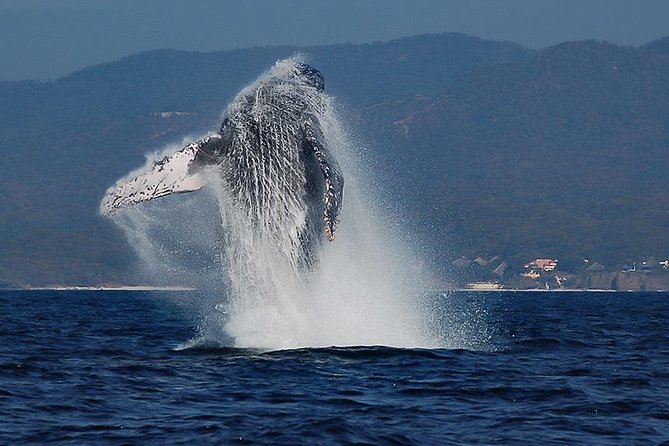
Many whale trips are built around finding an animal, pointing a camera, and heading back. This one gives you more context. The guide explains how humpbacks use the bay, why mothers and calves behave differently, and what you are seeing when a whale slaps its tail, raises its fluke, or surfaces beside another whale.
The research work matters, too. Wildlife Connection runs programs involving whales and dolphins, and the guide explains how observations from the boat can add to that work. You are not expected to become a field scientist in four hours, but you do get a clearer idea of how marine research works and why repeated sightings are useful.
The guides have strong marine backgrounds. Jemma, Gemma, and Camilla are all named by people who took the tour, and each is described as warm, lively, and highly trained in cetaceans. The company also identifies its staff as marine biologists, a marine ecology specialist, a science journalist, and a professional wildlife photographer.
That range of experience shapes the outing. You get facts, but you also get help reading the water. A guide may point out a mother staying close to a calf, a male competing for a female, or dolphins holding a regular territory.
More Whale and Dolphin Watching Tours in Mexico
- Dolphin & Whale Watching in Puerto Escondido
★ 5.0 · 278 reviews - Whale & Dolphin Watching Cruise in Puerto Vallarta All Inclusive
★ 4.0 · 212 reviews - Ocean Safari: Sea Lions, Mobula Rays, Dolphins, Orcas & Whales
★ 5.0 · 85 reviews
Meeting the crew at Marina Vallarta
The tour begins at Opequimar Centro Marino, at Av. Paseo de la Marina Sur 214 in Marina Vallarta. You return to the same point after roughly four hours.
The experience starts with a short educational session on land. This is a useful touch, especially if you have never watched whales before. You may see baleen and a whale vertebra, which make the animal’s scale easier to understand than a simple number such as 40 tons. The guide also explains which humpbacks visit Puerto Vallarta during winter and what kinds of behavior you might see.
After the briefing, the crew helps you board and provides life jackets. The boat is small and covered, with enough room for a maximum of 20 people. Many departures have had around 12 to 16 people, and a smaller group gives you a better chance to look over both sides without people blocking your view.
The covered design is helpful on a windy day and gives you some shelter from the sun. It does not turn the ride into a luxury cruise. This is a working wildlife boat, built for getting close enough to observe animals while keeping a proper distance.
The first run toward the humpbacks
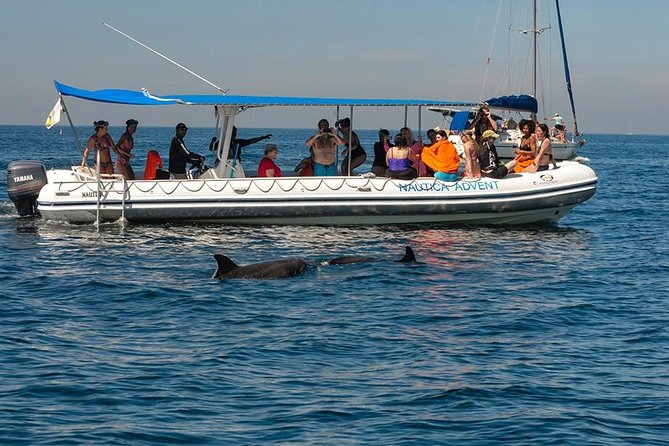
Once you leave the marina, the crew looks for signs of whales. A calm sea is not required for sightings, but rough conditions can make it harder to watch and photograph the animals. The operator says the trip depends on good weather, so a poor forecast can lead to a new date or a full refund.
The timing varies. Some outings have found whales within 15 or 20 minutes. Another began with about an hour of searching before the group reached an active area. This is worth keeping in mind if you want a perfectly timed show. The crew can read patterns and search efficiently, but nobody can schedule a breach.
Once whales are located, the captain positions the boat for useful views without crowding the animals. Captain Jorge and Captain Cesar are both praised by name for safe handling and good positioning. A skilled captain makes a real difference here. A whale may surface only briefly, and being behind it or off to one side can determine whether you see the back, the blow, or the full tail.
You might see a single whale traveling alone, several males competing for a female, or a mother with a young calf. The calves are not tiny. They are large animals in their own right, but their playful movements and close contact with their mothers make them easy to identify.
Reading whale behavior with a biologist
The guide does more than announce a sighting. You learn to watch for the blow, the curve of the back, the tail fluke, and repeated movements. The explanations help you understand why a whale may surface in one place, disappear, and return somewhere else.
One especially memorable behavior is a mother teaching a calf to communicate. A calf may slap its tail or move close to the mother, while the adult responds with repeated sounds or body movements. Guides have also pointed out mothers and calves traveling with an escort male, and groups of males competing for a female.
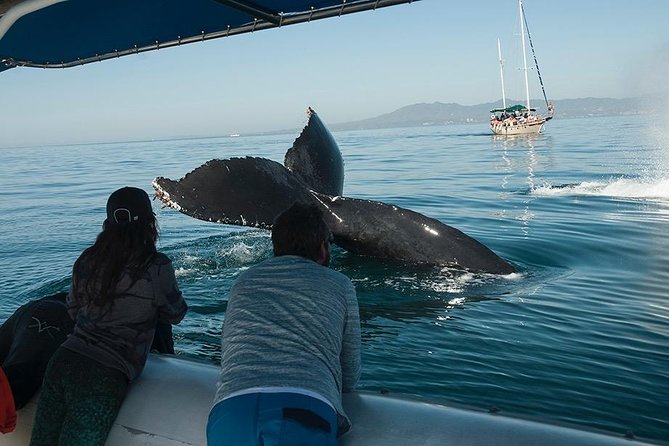
Breaching is possible, but it is not guaranteed. When it happens near the boat, the scale is startling. The humpback rises above the water with a force that makes photographs seem too small for the moment. You may also see pectoral fin slaps, tail slaps, rolling, or a whale raising its fluke before heading below the surface.
The hydrophone is one of the best parts of the tour. The guide lowers an underwater microphone and shares the sounds through the boat’s system. Male humpbacks produce songs that can carry through the water, and hearing them adds a second layer to the sighting. You are not only watching for a blow on the surface. You are listening to animals you cannot always see.
More Dolphin Watching with a Marine Biologist in Mexico:
- Portimão: Benagil Caves & Dolphins Watching with Biologist
★ 4.8 · 3,795 reviews - Lagos: Combo Dolphin and Benagil Tour with Marine Biologist
★ 4.7 · 2,352 reviews - Lisbon: Dolphin Watching with Marine Biologist
★ 4.9 · 1,853 reviews - Lagos: Dolphin Watch Tour with Professional Marine Biologist
★ 4.9 · 1,500 reviews
Finding dolphins, turtles, and giant mantas
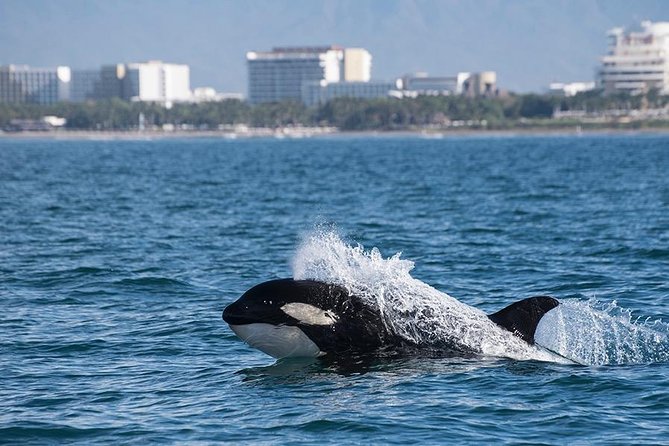
The tour is not limited to humpbacks. During the winter season, the crew combines whale watching with searches for dolphins. Possible species include bottlenose, spotted, spinner, and rough-toothed dolphins. Orcas and false orcas are listed as rare possibilities, so treat those as a bonus rather than a promise.
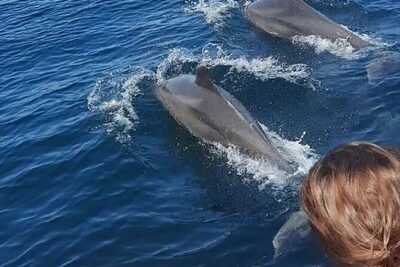
Dolphins may travel in large groups, and you could see them near whales or moving through their own area. A pod racing alongside the boat can be lively, but the biologist keeps the focus on identification and behavior rather than treating the animals as a simple photo backdrop.
Sea turtles and giant manta rays are also possible. One outing included a manta, while others included turtles and even a relaxed sea lion floating on its back. Blue-footed boobies have also been spotted. These extra sightings can make a quieter whale period feel worthwhile.
The key point is that this is a marine wildlife outing, not a whale-only guarantee. You may spend time watching several species, and the variety gives the guide more to explain. Still, humpback whales are the main reason to book during the winter season.
Food, comfort, and what to bring
Some outings include sandwiches and soft drinks. Camilla has even prepared sandwiches for the group, but you should not treat a specific menu as guaranteed unless the provider confirms it for your departure.
The boat has no bathroom. Use facilities before boarding and plan accordingly, especially if you are traveling with children or tend to get seasick. The trip lasts about four hours, which is long enough for several search areas but short enough to fit into a morning or afternoon in Puerto Vallarta.
Wear clothes that can handle spray and wind. A covered boat protects you from some sun, not all weather. Bring sun protection, water if advised by the operator, and a camera with a wrist strap or secure grip. Keep your attention on the water as well as your screen. A whale can surface and vanish while you are adjusting a phone.
Bring cash for a tip if you want to thank the crew. Several outings describe the captain and biologist as especially attentive, and tipping is a practical way to recognize that work.
How the $105 price holds up
At $105 per person, this is not the cheapest boat ride in Puerto Vallarta. The value comes from the crew and the small-group setup rather than from a long list of extras.
You are paying for about four hours on the water, a marine biologist who can explain behavior, a captain who knows how to position the boat, and a research program that uses observations from the outing. The hydrophone and introductory lesson add substance that a basic sightseeing cruise may not provide.
The small boat also matters. A large vessel can offer more room and a smoother ride, but it can make wildlife feel distant and crowded at the rail. Here, a group of 12 to 16 gives you a better chance to see both sides of the boat. The maximum is 20, so check the expected group size if having extra space is important to you.
The provider says it can guarantee finding animals and offers your money back if none are found. I would still treat this as a wildlife promise with practical limits. Animals can be unpredictable, and the experience depends on weather and sea conditions. The stated refund policy gives the booking more security, but it cannot guarantee a breach, a calf, or a pod of dolphins.
Morning or afternoon departure?
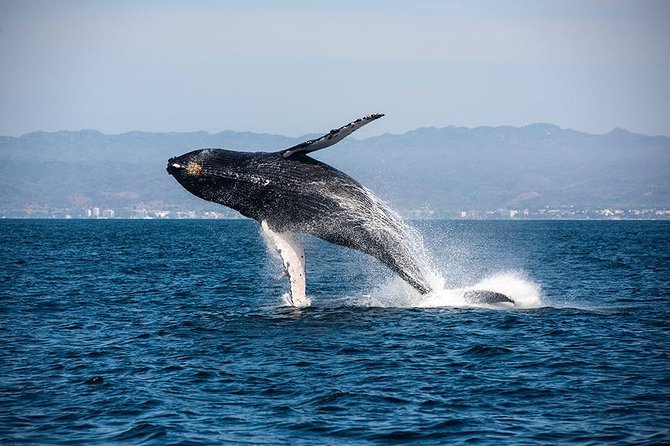
The available information does not give one fixed time for every departure, and wildlife does not follow a strict schedule. One morning trip reportedly had a slow search, while an afternoon trip produced whales soon after leaving. That does not prove one time is better than the other.
Choose based on your schedule, expected weather, and how you feel on the water. If you are concerned about heat or sun, the covered boat helps. If you want to spend the rest of the day at the beach or exploring Puerto Vallarta, select the departure that fits your plans.
A four-hour outing can become the centerpiece of your day. Leave enough room around it for the meeting point, boarding, and the possibility that the boat returns a little later than the exact four-hour mark.
Who should book this experience?
I would choose this tour if you want more than a quick whale photo. It suits adults, families with older children, couples, and anyone interested in marine biology. Teenagers may especially enjoy the combination of close wildlife sightings, whale sounds, and a fast-moving boat ride.
It is also a good choice for first-time whale watchers. The guide explains what to look for, and the crew helps with boarding and life jackets. You do not need prior knowledge of whales to follow the discussion.
Think carefully if you need a bathroom on board, dislike small boats, or have trouble with motion. The experience is active and weather-dependent, even though the boat is covered. It is not recommended for people more than seven months pregnant. Service animals are allowed, and the meeting point is near public transportation.
Booking, cancellations, and practical details
Confirmation arrives within 48 hours, subject to availability. This tour is often booked well in advance, with an average booking time of about 26 days, so reserve early if you are visiting during the winter whale season.
You can cancel for a full refund up to 24 hours before the start time. Cancellations or changes made within 24 hours are not refunded or accepted. If bad weather prevents the trip, you can choose another date or receive a full refund. The same choice applies if the minimum number of participants is not reached.
The tour is offered in English. It begins and ends at Opequimar Centro Marino in Marina Vallarta.
Should you book the whale and dolphin tour?
I would book it if you value expert interpretation, a small boat, and a real chance to support marine research. The strongest parts are the guide’s explanations, the hydrophone, the captain’s careful positioning, and the possibility of seeing mothers, calves, dolphins, turtles, and mantas in one outing.
I would skip it only if you need a restroom on the boat, want a quiet luxury cruise, or cannot accept the uncertainty of wildlife watching. For most people visiting Puerto Vallarta during winter, $105 is a fair price for four hours of close observation with a biologist rather than a simple ride past the bay.
FAQ
Where does the whale and dolphin tour begin?
The tour begins at Opequimar Centro Marino, Av. Paseo de la Marina Sur 214, Marina Vallarta, Puerto Vallarta, Jalisco, Mexico.
Where does the tour end?
The activity ends back at the same meeting point in Marina Vallarta.
How long does the experience last?
The tour lasts approximately four hours.
How much does the tour cost?
The listed price is $105 per person.
How many people can join the boat?
The maximum group size is 20 people. Some departures have had about 12 to 16 people.
What animals might I see?
Possible sightings include humpback whales, bottlenose dolphins, spotted dolphins, spinner dolphins, rough-toothed dolphins, turtles, giant manta rays, sea lions, and blue-footed boobies. Orcas and false orcas are possible but less common.
Can I hear whale songs?
Yes. The guide may use a hydrophone to share the sounds of whales underwater.
Is there a bathroom on the boat?
No. Use a restroom before boarding.
What is the cancellation policy?
You can cancel at least 24 hours before the start time for a full refund. Cancellations or changes made less than 24 hours before the tour are not accepted and are not refunded. Poor weather or failure to meet the minimum group size may result in a new date or a full refund.
Newly spotted around Mexico
- Dolphin & Whale Watching with Marine Biologists★ 5.0 · 31 reviews
- Royal Garragon with Dolphin Encounter in Isla Mujeres★ 3.0 · 2 reviews
- Meeting at the Dolphinarium★ 4.0 · 13 reviews
- Tulum & Dolphin Connection from Cancun★ 3.5 · 3 reviews
- The only Natural Space Dolphin Encounter in Cabo Optional Pickup!★ 5.0 · 46 reviews
- Private Wild Dolphin Encounter Day Trip★ 5.0 · 4 reviews
- Riviera Maya: Swim with dolphins Interax★ 4.4 · 8 reviews
- Riviera Maya: Swimming Experience with Dolphins★ 4.5 · 21 reviews
Puerto Vallarta Dolphin Watching Tours, side by side.
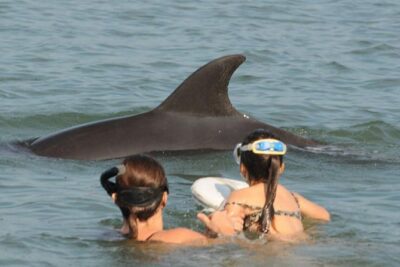
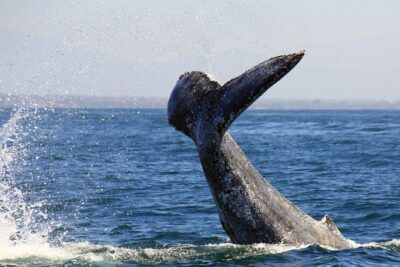
Whale & Dolphin Watching Cruise in Puerto Vallarta All Inclusive
Read our review →